Audrey Moores is a Professor at McGill University who researches and teaches green and sustainable chemistry. She is also the President of the College of the Royal Society of Canada. She develops syntheses and chemical processes which are more respectful of the environment and our health, including towards the valorization of waste from biomass, using solvent-free techniques. For the International Day of Women and Girls in Science, Audrey shares what inspires her work, why it matters for the future, and why empowering girls and women to pursue STEM careers is so important.
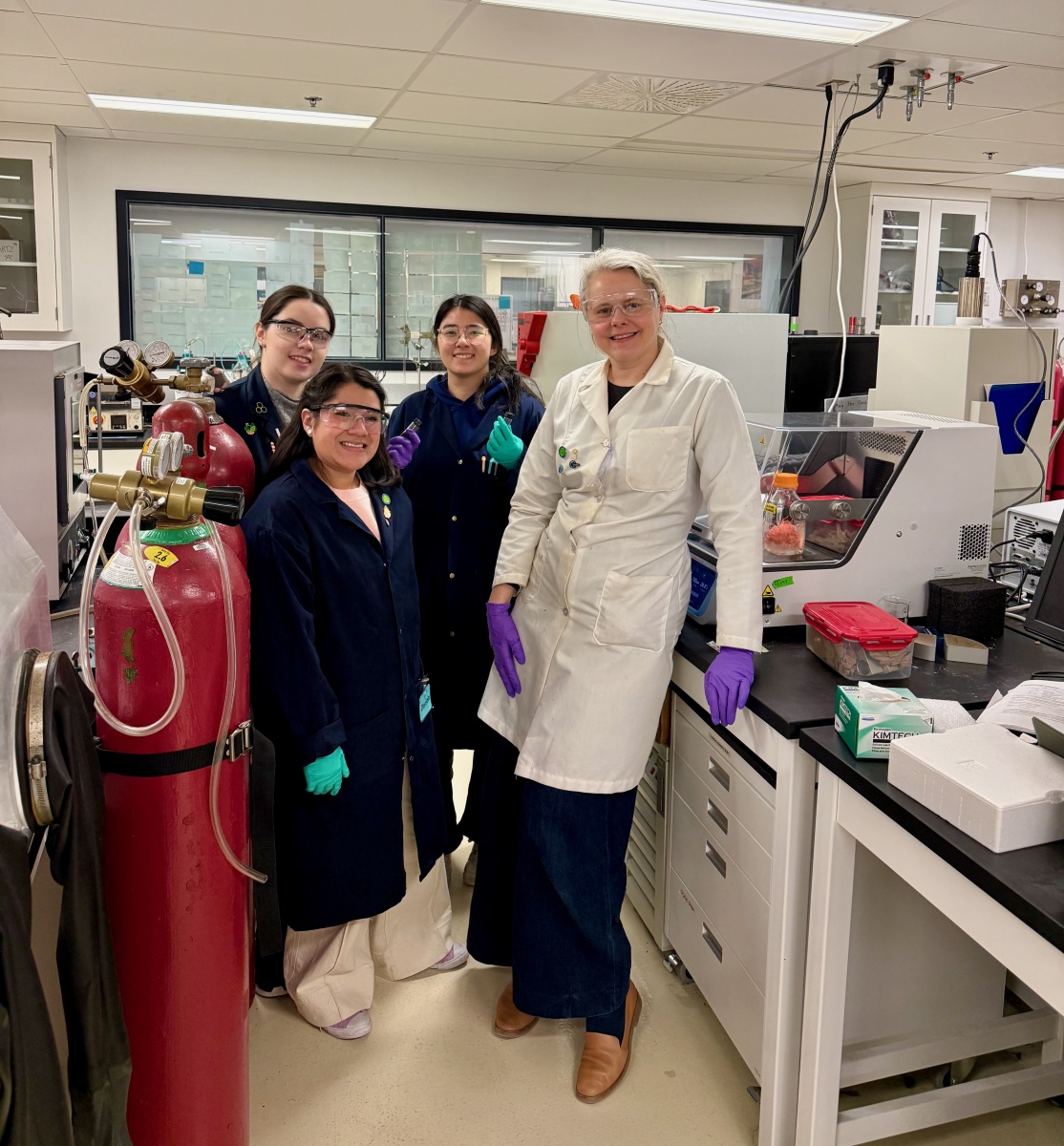
From left to right: Justine Sauvé-St. Pierre, Daniella Oliván Ponce, Jasmine Hong and Audrey Moores (Photo credit: Austin Richard)
Q: To start, could you briefly introduce yourself?
A: I am a Professor of Chemistry at McGill University, where I teach and conduct research in green and sustainable chemistry. I am also President of the College of the RSC, where I work to promote inclusive excellence, trust in science, languages in research and Indigenous engagement. My research focuses on developing environmentally responsible chemical processes, particularly those that valorize biomass waste and reduce reliance on solvents and hazardous reagents.
Q: What drew you to green and sustainable chemistry?
A: I was drawn to green chemistry by the realization that chemistry is a very powerful science, able to change matter, while it has a responsibility to reduce harm. The idea that we can redesign chemical processes to be safer, cleaner, and more efficient has deeply motivated me and aligned with my values as a scientist and educator.
Q: Why does your research matter right now, both globally and here in Canada?
A: Globally, we are facing urgent challenges related to climate change, resource depletion, biodiversity loss, and pollution. Chemistry sits at the heart of many of these issues. In Canada, with our strong natural resource base and research ecosystem, there is a real opportunity to lead in sustainable innovation. Developing circular, low-impact chemical processes is essential for both environmental stewardship and economic resilience. For instance, I work with local fishermen in the North of Quebec to build a process to valorize crustacean waste into high value materials.
Q: What part of your work do you find most rewarding?
A: Mentorship is by far the most rewarding part of my work. Seeing students and trainees grow in confidence, find their scientific voice, and go on to make their own contributions, both inside and outside academia, is incredibly meaningful. Supporting the next generation of scientists is a responsibility I take very seriously.
Q: Why is it especially important to create more opportunities for women and girls in STEM today?
A: The RSC has positioned the notion of inclusive excellence at the heart of its strategic planning. Being able to bring at the table diverse perspectives, experiences, viewpoints, is the only way to build a truly strong and resilient body of knowledge. Grand challenges faced today cannot be solved by classic, single-minded approaches. Women are impacted differently and often more than their male counterparts by climate changes (learn more here), meaning that their voices must be heard and their mind creating solutions, with others. Creating opportunities for women and girls in STEM is not only a matter of equity: it is essential for addressing complex global challenges effectively.
Q: From your experience, what are the most effective ways institutions and individuals can help create those opportunities?
A: Institutions must move beyond statements of intent and implement concrete, sustained actions. Equitable hiring and promotion practices, transparent evaluation criteria, and strong mentorship structures have been created, and have brought progress. But to me, true change will come from identifying barriers and actioning changes that can really impact the life of academics, in a way to reduce disparities. For instance, I worked at McGill to address disparities caused by family care situations. This type of work is intended to bring concrete solutions, while shifting discourse from “family care is a women’s issue” to helping all community members in this situation, including male colleagues who are true allies to their spouse.
Q: Looking back, is there a resource, support, or piece of knowledge you wish you’d had earlier in your career?
A: I wish I had known earlier how normal self-doubt and imposter syndrome are, even among very accomplished scientists. Understanding that uncertainty is part of growth would have made certain moments easier to navigate.
Q: What advice would you give to a young woman considering a career in science?
A: Be curious, be persistent, and don’t wait to feel “ready” before taking opportunities. Seek out mentors and peers who support you and remember that there is no single path to success in science: your perspective is valuable precisely because it is your own.
Q: Why is it important to celebrate the International Day of Women and Girls in Science?
A: This day highlights both the contributions women have made to science and the work that remains to be done. Visibility matters as it helps young people see themselves in scientific careers and reminds institutions of their responsibility to foster inclusive and equitable research cultures.
Q: To close, in one word, what drives you to do the work you do?
A: Curiosity