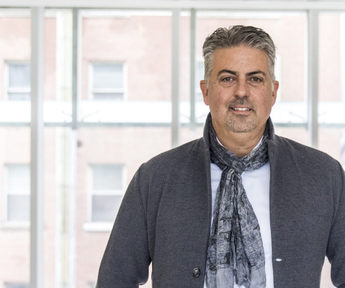

A clinical neuropsychologist and global expert on HIV’s neurobehavioural impacts, he’s dedicated his career to ensuring all Canadians – especially those living with HIV, syphilis and other STIs – get the care they deserve, no matter where they are.
On any given week, Sean B. Rourke might be presenting research in the US or the UK, coordinating teams in northern Manitoba, or launching new health initiatives across Canada. At the heart of his work is a simple, urgent idea: healthcare only works if it reaches the people who need it most.
“We’re doing things that are making a real difference in people’s lives,” he says. “But there’s still so much to do.”
Early Curiosity, Lifelong Direction
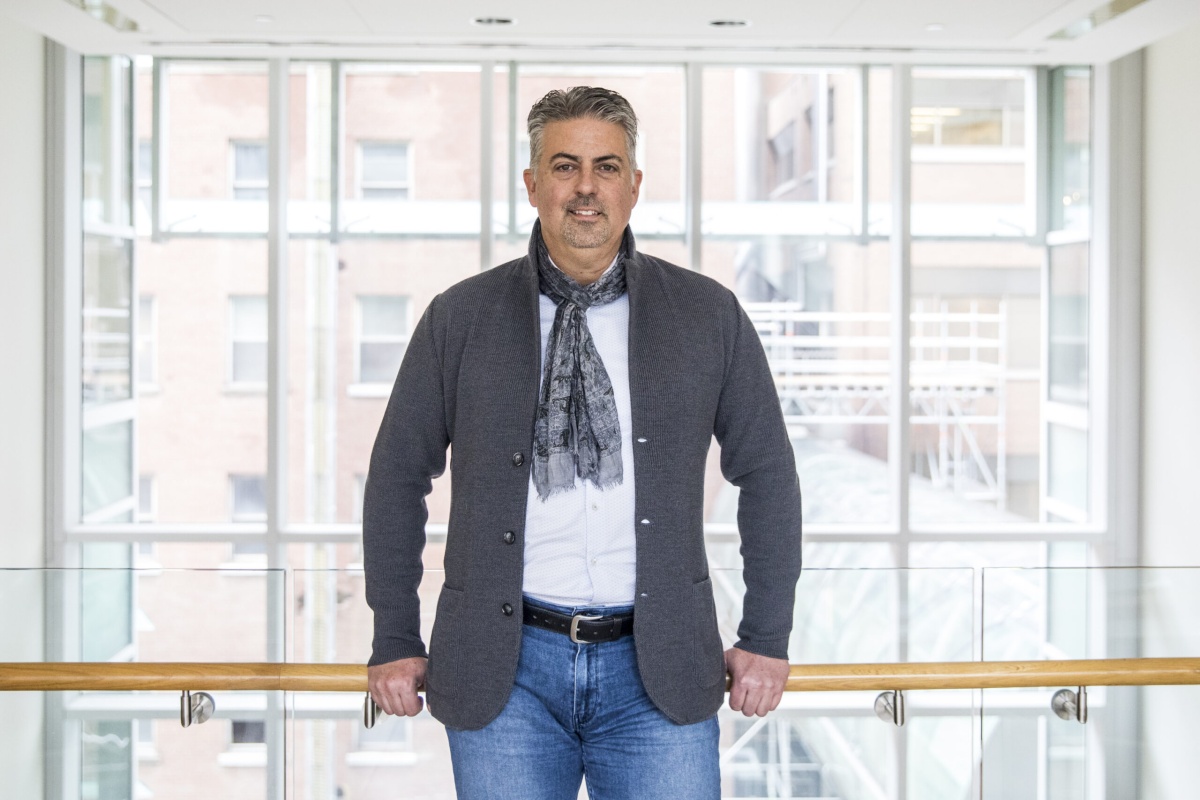
Rourke’s path into healthcare began in Windsor, Ontario, in a household defined by curiosity. His father, a child neuropsychologist and one of the early pioneers in the field, helped shape Sean’s early worldview.
Neuropsychology – focused on understanding how the brain and behaviour connect – was a constant topic of discussion at home. Leading researchers from around the world regularly visited, exposing Rourke to big ideas at a young age.
Yet his interests weren’t purely academic. He describes himself as naturally hands-on and visual. “If I hadn’t gone into this field, I probably would’ve been an architect or a builder,” he says. “I really like taking things apart and understanding how they work.”
He pursued studies in biology, including genetics and cardiovascular physiology, and even early versions of artificial intelligence. But it was a course in physiological psychology that ultimately changed his trajectory, leading him toward a career in neuropsychology.
Alongside his brothers, Rourke completed two undergraduate degrees at the University of Windsor before heading to California for further studies. The move brought a degree of culture shock, but also opportunity. “It was a great place to wear shorts year-round,” he recalls, “and also to train as a clinical psychologist and a neuropsychologist.”
Understanding the Brain – and Its Resilience
During his early career, Rourke focused on how heavy alcohol use affects the brain. His research led to an important finding: the brain has a remarkable capacity to recover after someone stops drinking – but that recovery depends on age.
He found that individuals who stop drinking before about age 50, and who do not have major underlying health issues, can experience almost complete brain recovery. After that point, recovery tends to be less complete.
“That work connects strongly to what we understand today about brain plasticity,” he explains. “And the importance of things like exercise and cardiovascular health. I often say: what’s good for your heart is good for your brain.”
A Turning Point in HIV Care
In 1995, Rourke was recruited to St. Michael’s Hospital in Toronto at a pivotal moment in HIV treatment. Combination antiretroviral therapy (often then referred to as “the cocktail”) was transforming what had once been a fatal diagnosis into a manageable chronic condition.
There was growing optimism that people could live much longer. But questions remained, particularly around brain health, including dementia and cognitive impairment.
Rourke decided to act.
He established the first clinic focused specifically on HIV-related cognitive concerns, assessing memory, cognition, and overall brain function in people living with HIV. Over time, that effort evolved into a broader neurobehavioral program, combining clinical care with research and always centering patients’ lived experiences.
Progress – and Persistent Epidemics
Today, HIV treatment has advanced significantly. In addition to daily antiretroviral pills, Canada now offers long-acting injectable therapies, providing new options for patients.
But despite these advances, HIV remains an epidemic in Canada.
“There are about 7,000 to 8,000 people in Canada who are undiagnosed and not benefitting from life-saving treatments,” Rourke says. “And most concerning, the rates of HIV in the prairies are worse than in some parts of Africa.”
Rourke also explains that infectious syphilis rates have exploded in recent years, especially in the prairies and in northern communities. Outbreaks of congenital syphilis have affected hundreds of babies in each of the prairie provinces, with hundreds of stillbirths linked to a lack of prenatal care.
“Other diseases, like measles, grab headlines when a child dies,” Rourke notes. “But when it’s related to HIV or syphilis, it largely goes unnoticed.”
As Sean emphasizes, “This shouldn’t be happening in Canada.”
Confronting Stigma and Systemic Barriers
Rourke points to stigma and inequity as major drivers of these “silent epidemics.”
“As Canadians, we don’t openly talk about sexual health,” he says. “There’s still stigma and discrimination – especially in healthcare settings. Some people, especially Black, racialized and Indigenous people, may even avoid the system because they’ve had negative experiences, been treated badly or don’t feel safe.”
For Indigenous communities in particular, systemic barriers rooted in historical trauma related to residential schools and ongoing discrimination continue to limit access.
In remote regions, individuals may need to take multiple flights just to get tested and then the follow-up to receive treatment.
“A key insight of my work is that traditional healthcare systems don’t reach everyone,” Rourke explains. “So, we need community-based solutions that are culturally safe.”
Innovation in a Time of Crisis
In November 2020, Rourke and his team received approval for Canada’s first HIV self-test. But the timing coincided with the COVID-19 pandemic, forcing them to quickly rethink how to deliver these tests to those who needed them most.
Their solution was the I’m Ready to Know app, allowing individuals to order testing kits online and receive them anywhere in the country.
“Self-testing is critical because it allows people to learn their status privately and safely and then be able to take the next steps to take care of their health” Rourke says. “The tests are over 99% accurate.”
Since its launch, the program has distributed more than 20,000 free HIV testing kits.
Because of the success with I’m Ready, Rourke was asked by the Government of Canada to procure tests and then help build and support over 400+ front-line community-based agencies to distribute HIV self-tests to key populations most at risk of acquiring HIV. Funded for 2 years, they reached 100,000 people across Canada to get tested for HIV. “Scaling these public health interventions with affected communities is how you address health inequities” Rourke says.
Meeting People Where They Are
The idea for one of Rourke’s most impactful initiatives began with a simple question.
During the pandemic, Debby Warren, Executive Director of Ensemble Moncton, was going to have to shut her doors to her clients with mental health and addiction challenges because of the restrictions, but a few days before this happened she was at a health fair and was introduced to a company that was exploring using vending machines to dispense harm reduction supplies. She immediately saw the opportunity to use these machines in her community. And as she began to stock the machines, she reached out to Sean with a proposal: could HIV testing kits be distributed the same way?
“And I said, ‘That’s a great idea,’” Rourke recalls.
In 2023, that idea became Our Healthbox – a network of community-based vending machines offering free access to HIV self-test kits, naloxone, other harm reduction supplies, and other things we often take for granted that people need to take of their health.
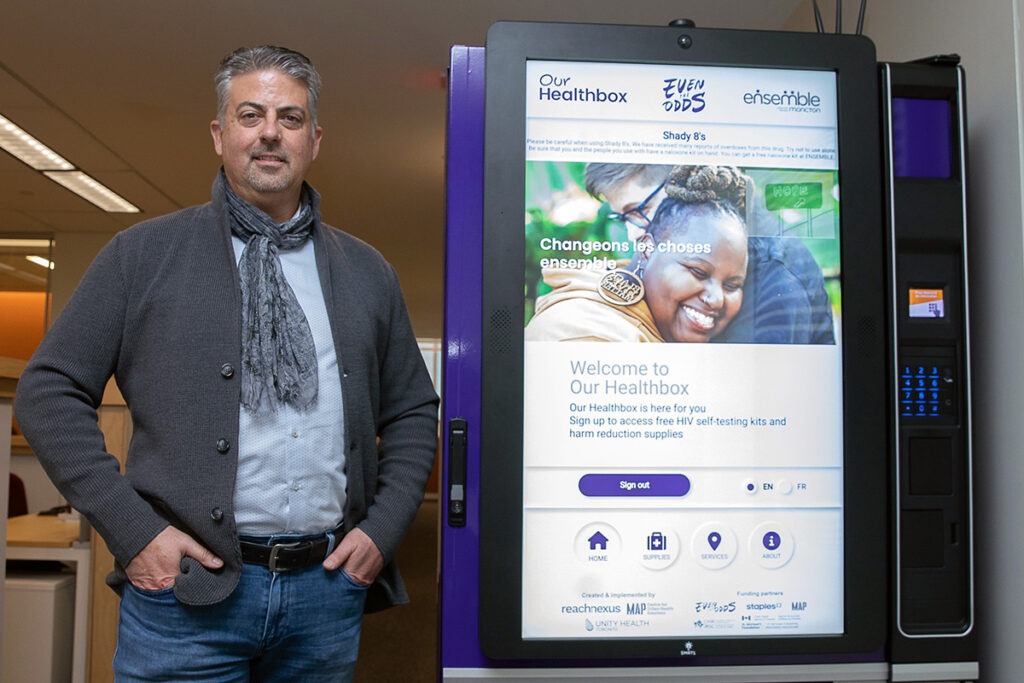
Photo Credit: Unity Health Toronto
Today, dozens of machines operate across Canada, each tailored to local needs and connected to real-time data systems that track usage and help to improve program delivery. The goal is ambitious: 100 “Healthboxes” nationwide, particularly in high-need areas.
The program works through partnerships with frontline organizations, health centres, and public health authorities. Participants sign up to use the machine using a code they generate (it’s anonymous) and then they have access (usually 24/7) to testing kits, harm reduction supplies, and other wellness items (such as hats and gloves, food items, or smudging kits in Indigenous communities). People can access what they need for their health without stigma or judgement.
As of beginning of April 2026, Our Healthbox has reached 18,000+ individuals.
A New Model of Care
Rourke’s work continued to expand in 2025 with the launch of the Ayaangwaamiziwin Centre – an initiative developed in collaboration with Indigenous leaders, HIV advocates, healthcare workers, medical officers of health, government workers, researchers, and people with lived experience.
Named after the Ojibwe word for “carefulness and preparedness,” the centre was created in response to address rising rates of HIV and syphilis, particularly in Indigenous communities across the prairies.
Rather than a single facility, the centre operates as a coordinated network of front-line organizations connected with community-based health care teams and with peer navigators delivering culturally appropriate testing, prevention, and treatment services to underserved communities in small and large urban centres but also in rural and remote areas too. Rourke emphasized – “We go to them and meet them where they are.”
In its first year alone, the initiative reached more than 2,500 people to get tested and connected to care. “It’s working. In Alberta, the scaling up of rapid point-of-care testing has led to an overall reduction of syphilis by 25%, helping to change the curve of the outbreak.”
Rourke is quick to emphasize that these successes are collective.
“It takes a village,” he says. “I’m just one part of a much bigger system we are building together.”
“People Deserve It”
In recognition of his work, in 2025, Rourke was awarded the inaugural RSC Eric Jackman Prize for contributions that advance human well-being through behavioural and social science research.
For him, the award is meaningful not as a personal achievement, but as a spotlight on the ways we can have real-life health impact for those who need it the most in our society.
“I love what I do,” he says. “It’s out of a sense of duty - I’m here to serve.”
When asked to describe – in one word – why it’s important to celebrate One Health Day, Rourke paused before offering a simple answer.
“I’ll give you three: people deserve it.”
That belief is the foundation of his work: that everyone deserves access to healthcare where they are treated with respect and dignity. And it’s a mission he continues to pursue – relentlessly, collaboratively, and with a clear sense of purpose.
More on Sean
Sean is a Clinical Neuropsychologist and Scientist with the MAP Centre for Urban Health Solutions with the Li Ka Shing Knowledge Institute of St. Michael’s Hospital and Professor of Psychiatry, University of Toronto.
He is the Director of REACH Nexus in HIV/AIDS that is focused on using program science to develop, implement and scale testing and care solutions in HIV/AIDS.
More on Sean: https://maphealth.ca/rourke/ and REACH Nexus at https://www.reachnexus.ca
Written by Paige Beveridge, RSC Communications Manager, communications@rsc-src.ca