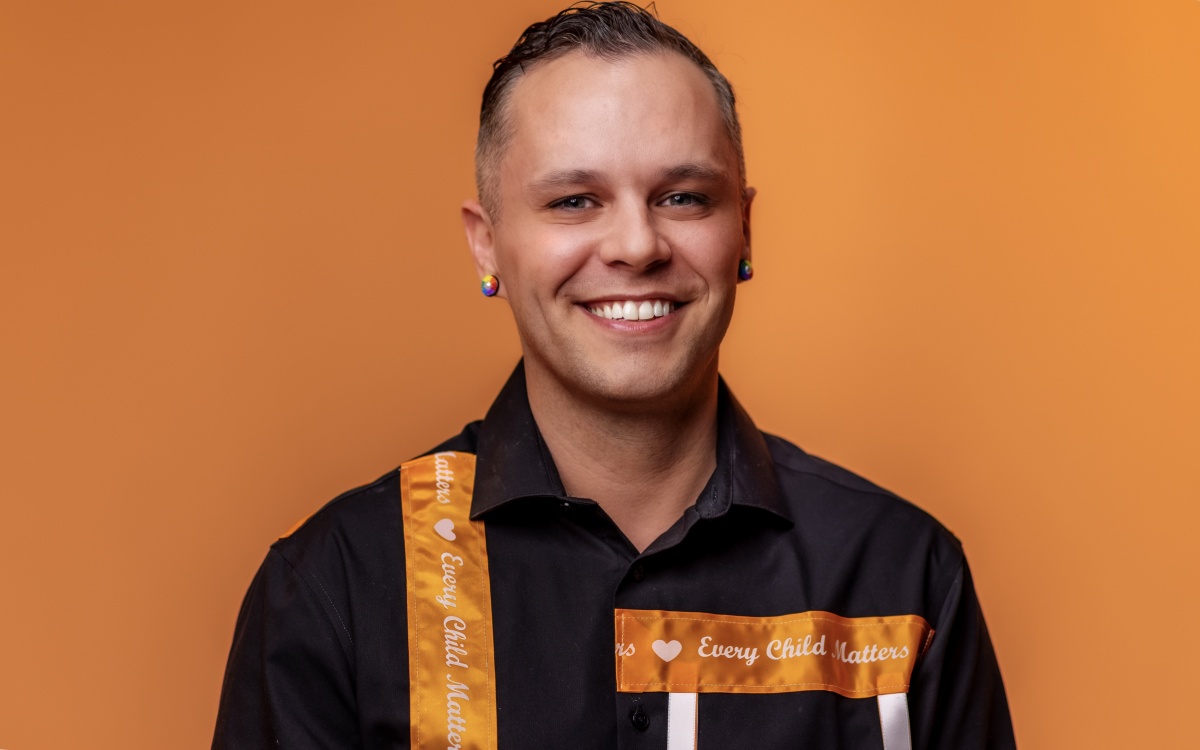
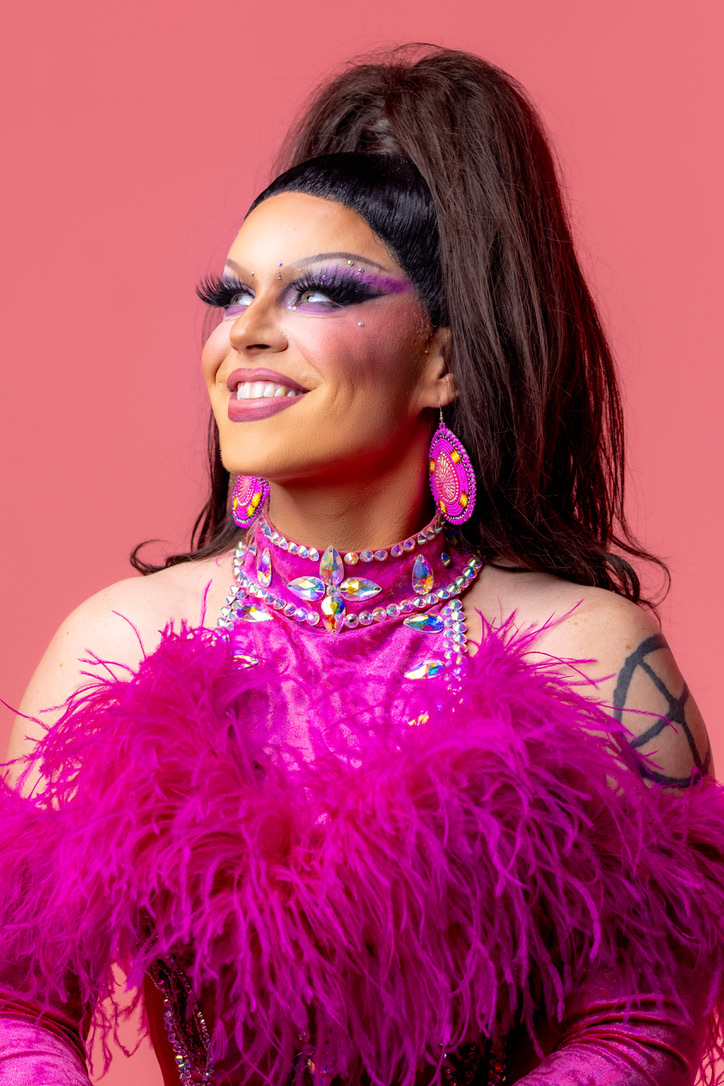
Jaris Swidrovich is a queer, Two-Spirit, Saulteaux, and Ukrainian pharmacist, Assistant Professor and Indigenous Engagement Lead at the Leslie Dan Faculty of Pharmacy at the University of Toronto – and, as Priss Cryption, is a drag queen working to advance HIV prevention.
Jaris originally planned to become a drama teacher before a pharmacy application redirected their path. Pharmacy quickly became a passion, alongside a commitment to strengthening Indigenous representation in the profession and addressing healthcare inequities – particularly the low awareness and uptake of pre-exposure prophylaxis (PrEP) among Indigenous Peoples in Canada.
In 2025, Jaris attended the Taikura Summit in Aotearoa New Zealand through the Tri-Academy Partnership on Indigenous Engagement, where they had the opportunity to share this work while connecting with Indigenous scholars from Canada and the Pacific to explore shared barriers Indigenous academics face within institutional systems.
For National Indigenous Peoples Day, Jaris reflects on their experience at the summit, their “accidental” path into academia, and their hopes for the future.
Q: Can you start by telling us a bit about yourself?
A: My name is Jaris, which rhymes with the city Paris and has a hard J as in January. My last name is Swidrovich, which is from my father’s Ukrainian family line. On my mother’s side, I am Saulteaux (Anishinaabe) and a member of Yellow Quill First Nation, which is on Treaty 4 territory in Saskatchewan. I identify as Two Spirit (he/they) and queer and live with a permanent non-visible disability. My mother was a 60s Scoop survivor and her mother and grandmother both survived Gordon Indian Residential School, which was the last residential school to close in 1996. I have spent most of my life in Treaty 6 territory and the Métis homelands (Saskatoon, SK) and more recently have relocated to Treaty 13 (Toronto, ON).
Q: You’re a pharmacist, pharmacy professor, and researcher. What drew you to these paths? How have they shaped each other?
A: Pharmacy and the subsequent academic career in pharmacy kind of happened by accident. I was originally enrolled in university to become a high school drama teacher. When my peers told me it would be very difficult to land a teaching contract in Saskatoon, I dropped all my courses and registered in all the courses necessary to instead apply to medicine. In a biochemistry course in my second year of arts and science courses, a classmate of mine informed me about an upcoming deadline to apply to pharmacy, which I had never considered. I looked it up and learned I already completed all the prerequisites required to apply to pharmacy, then applied, then was accepted! I did later still apply to medicine and was accepted and asked for a deferral to finish my fourth and final year of pharmacy school, which they granted. To my own surprise, I totally fell in love with hospital pharmacy, which I didn’t get to experience until my last semester of my final year of my Bachelor of Science in Pharmacy (BSP), and I felt an overwhelming sense of responsibility to work on Indigenous representation and education in the pharmacy discipline, which was sparse. Years later I went on to complete a Doctor of Pharmacy (PharmD) degree at the University of Toronto and returned to Saskatoon where I became a Clinical Coordinator at St. Paul’s Hospital and with a clinical practice in adult inpatient HIV care. During my time in the hospital I fell in love with the various levels of education, teaching, and mentorship I was involved with, and I also developed a strong curiosity about many different clinical and social issues I witnessed, which prompted me to apply for a position in academia in 2015 and I have been a faculty member ever since!
Q: What’s a discovery from your work that you think more people should know about?
A: Perhaps this would be my research in HIV prevention (specifically pre-expsoure prophylaxis; PrEP) and the low awareness and uptake of PrEP among Indigenous Peoples in Canada. Indigenous Peoples are the most over-represented group among those acquiring and living with HIV in Canada, yet prevention strategies like PrEP are widely underpromoted to Indigenous Peoples and with few interventions to make access to PrEP easier.
Q: Last November, you traveled to Aotearoa New Zealand for the Taikura Summit as part of the Tri-Academy Partnership on Indigenous Engagement. What was that experience like?
A: It was fantastic! I am always struck by the overwhelming kindness and hospitality of Māori folks and the country is gorgeous. The Taikura Summit, specifically, was yet another powerful gathering of respected Indigenous thought leaders whom I have looked up to for some time and consider them as my mentors – even if they don’t know it! It was wonderful to establish and nurture international relationships among Indigenous colleagues, researchers, community members, and others.
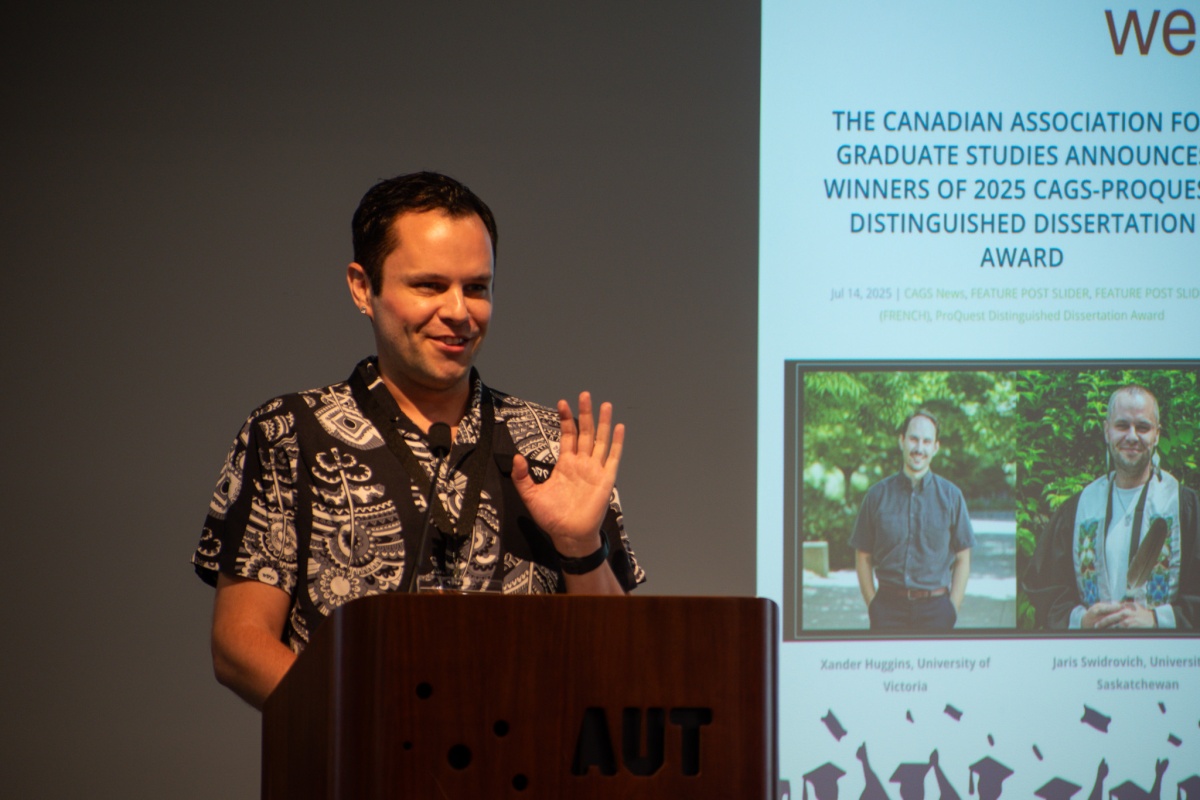
Photo: Royal Society Te Apārangi
Q: What insights or moments from the summit have stayed with you, and how do you see those lessons having influence outside the summit?
A: The struggles we as Indigenous academics face within academic institutions and how institutional and academic processes do not always adequately prepare us for success, nor do they adjudicate our success in ways that best reflect Indigenous community expectations, processes, and impacts.
Q: At the summit, attendees were introduced to Priss Cryption! Can you tell us more about her, and how you’re using drag to power community-led HIV prevention?
A: Yes! Priss Cryption has been very busy this past year and is finally launching her own website and dozens of fun, informative, and accessible educational videos to help spread the word about and uptake of HIV pre-exposure prophylaxis and other HIV prevention strategies. She is working with Indigenous and non-Indigenous communities across a variety of areas, including HIV, chronic pain, sexual health, and more, and with lots more to come!

Q: What’s next for you — what projects or goals are on the horizon?
A: I am applying for grants to pilot pharmacist-led assessment, prescribing, administration, and follow-up of HIV prevention in Ontario, including HIV PrEP, HIV post-exposure prophylaxis (PEP), and doxycycline post-exposure prophylaxis (DoxyPEP) for preventing sexually-transmitted infections (STIs). We are still not meeting provincial and national targets for HIV prevention and treatment, and with a primary care crisis and crowded emergency rooms with long wait times, pharmacist-led care in this space makes perfect sense.
Q: If you could sum up your hope for the future in just one word, what would it be?
A: Belonging.
Q: What advice would you give to those inspired by your work?
A: Stay curious and always remember where you come from and all the work of people before you and I who made what we do possible. While it is an honour to know there may be people inspired by my work, I always want to emphasize that I am only able to do this work because of so many people who came before me, the strength and resilience of my family, and the ongoing mentorship of Indigenous academics, clinicians, and community members who lift me up and guide me in a good way.
Q: In your opinion, why is it important to celebrate National Indigenous Peoples Day?
A: Every day is Indigenous Peoples’ Day in what we now call Canada. Despite repeated attempts to “get rid of the Indian problem,” Indigenous Peoples are still here, still strong, and remind all of us of the roles and importance of land, water, sky, animals, and community in our ongoing sustenance and sustainability of life and living in a good way.