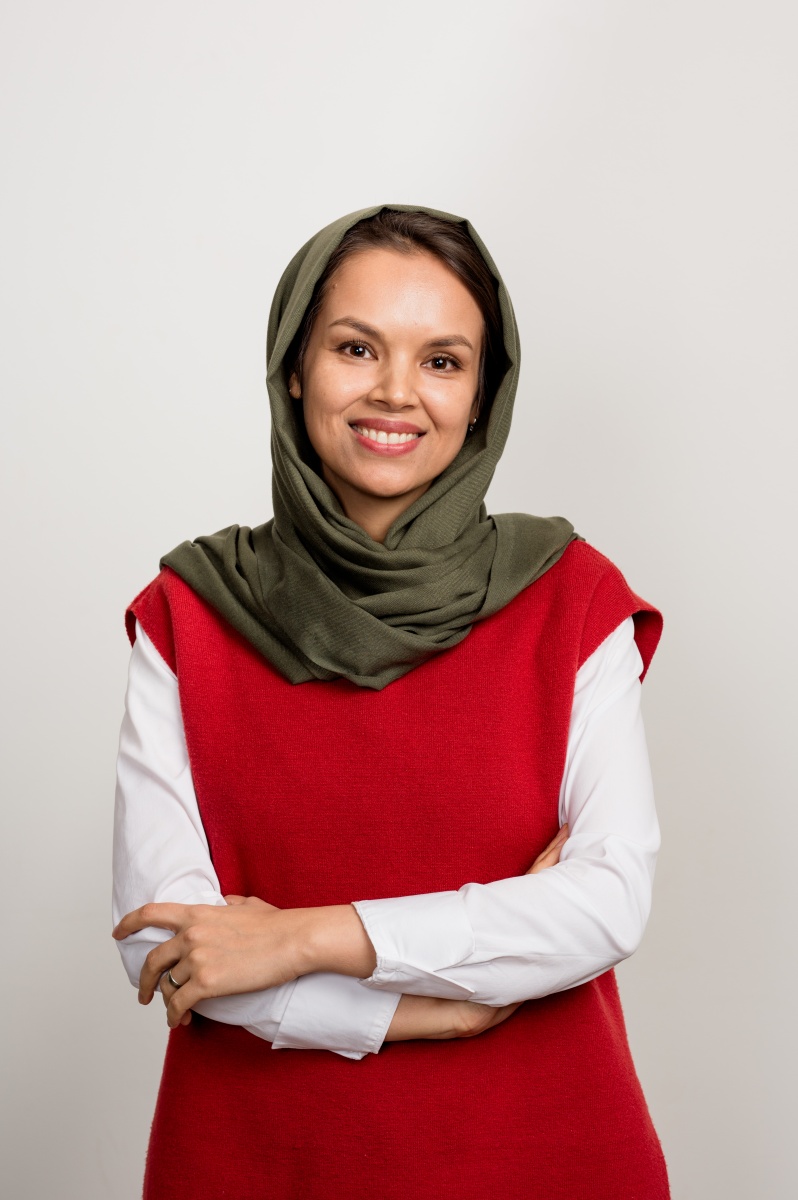
Narges Noori (RSC College) is an artist, educator, and advocate whose work is grounded in resilience and resistance. Though she discovered her creative voice early, the foundation of her career was forged at Kabul University, where she served as a professor in the Faculty of Fine Arts. Her classroom was a refuge — a place where young artists could claim their voices and imagine their futures, no matter what was unfolding beyond its walls.
When the Taliban returned to power, Noori was forced to pivot — and ultimately, to flee. She speaks of the immense responsibility she felt in that moment. Through storytelling, she chose to amplify the voices being silenced. She began writing children’s books for Afghan girls, creating on the page what she once built in her classroom: a sanctuary. Within those stories, girls could see their strength, their agency, and a path forward amid oppression.
Today, as an author of two children's books, Noori continues to champion Afghan girls — but her vision has widened. She is speaking to girls everywhere, urging them to imagine boldly, recognize their power, and write their own stories, wherever they are in the world.
Q: Please introduce yourself!
A: I am an illustrator, children’s book author, and educator working at the intersection of art and women’s empowerment. My professional journey took a defining turn in Afghanistan, where I used illustration and teaching as spaces for expression and resilience.
I was awarded an IIE–Artist Protection Fund Fellowship and was in residence at the University of Alberta. I now teach as a sessional instructor at MacEwan University while continuing to develop my personal artistic projects, particularly children’s books that amplify women’s voices across cultures.
Q: What drew you to creating stories for children?
A: I am drawn to creating stories for children because childhood is where imagination is still wide open. The stories we encounter early in life quietly shape how we see ourselves and what we believe is possible.
As an illustrator, I am especially drawn to the visual world of children’s books. Colour, movement, and expression can communicate emotions that words alone cannot. I love how an image can create a feeling before a sentence is even read.
For me, children’s literature brings together meaning and beauty. It allows me to combine storytelling with visual language in a way that feels both playful and deeply purposeful.
Q: How has your experience as a woman, growing up in Afghanistan and witnessing the Taliban’s return, shaped your storytelling?
A: The return of the Taliban was a turning point in my work. From that moment, I felt a deeper sense of urgency and responsibility in my storytelling.
As an Afghan woman, seeing girls lose their basic rights was very painful for me. I realized that silence is the worst response. I may not be able to change political realities, but I can choose not to stay silent through my art.
Today, my stories are a way to show the strength, dignity, and humanity of girls and women. For me, storytelling is not just art, it is a way of standing beside those whose voices are not being heard.
Q: You taught drawing and illustration at Kabul University for eight years. What was that experience like?
A: It was a meaningful and formative period in my life. Teaching for me was not only about technique; it was about helping students see the value of their own creative voice.
Art was not always fully respected in society, and students sometimes had to defend their choice of studying art. But in the classroom, I tried to create a space where they felt confident and taken seriously.
One of the most rewarding parts for me was seeing students grow professionally, receiving commissions and realizing that illustration could become a real career. At the same time, I encouraged them to think carefully about the stories they chose to tell, and to understand the social responsibility that comes with creating images.
Looking back, I see how much courage and commitment it required simply to pursue art in that environment. That experience shaped me deeply as an educator.
Q: How did relocating to Canada and continuing your work at the University of Alberta reshape your voice?
A: Before coming to Canada, my main focus was Afghan girls. My work was shaped by a strong sense of responsibility toward them and their realities.
After relocating and continuing my work at the University of Alberta, my voice expanded. I still care deeply about Afghan girls, but now I see my audience as all girls, regardless of race or nationality. My stories became more inclusive and more connected to global conversations about women’s dignity and rights.
Being in an environment where different forms of art and different ways of thinking are respected gave me more confidence. I feel more freedom in expressing my ideas. The academic space here is supportive, and that support allowed me to reflect more deeply on my work and grow as both an artist and an educator.
Q: Your work centers on empowering girls and women. What impact do you hope your stories have on the next generation?
A: I hope my stories help girls see their own strength more clearly. My goal is to remind them of the power they already carry within themselves.
Sometimes empowerment comes from small moments of recognition, when a girl sees herself reflected in a character and feels understood. I want young readers to grow up with a strong sense of dignity and self-worth, knowing that they are capable of shaping the world around them.
If a young reader closes one of my books feeling more confident, more aware, or more compassionate, then I believe my work has done what it was meant to do.
Q: Is there one illustration you’ve created that stands out to you? Why?
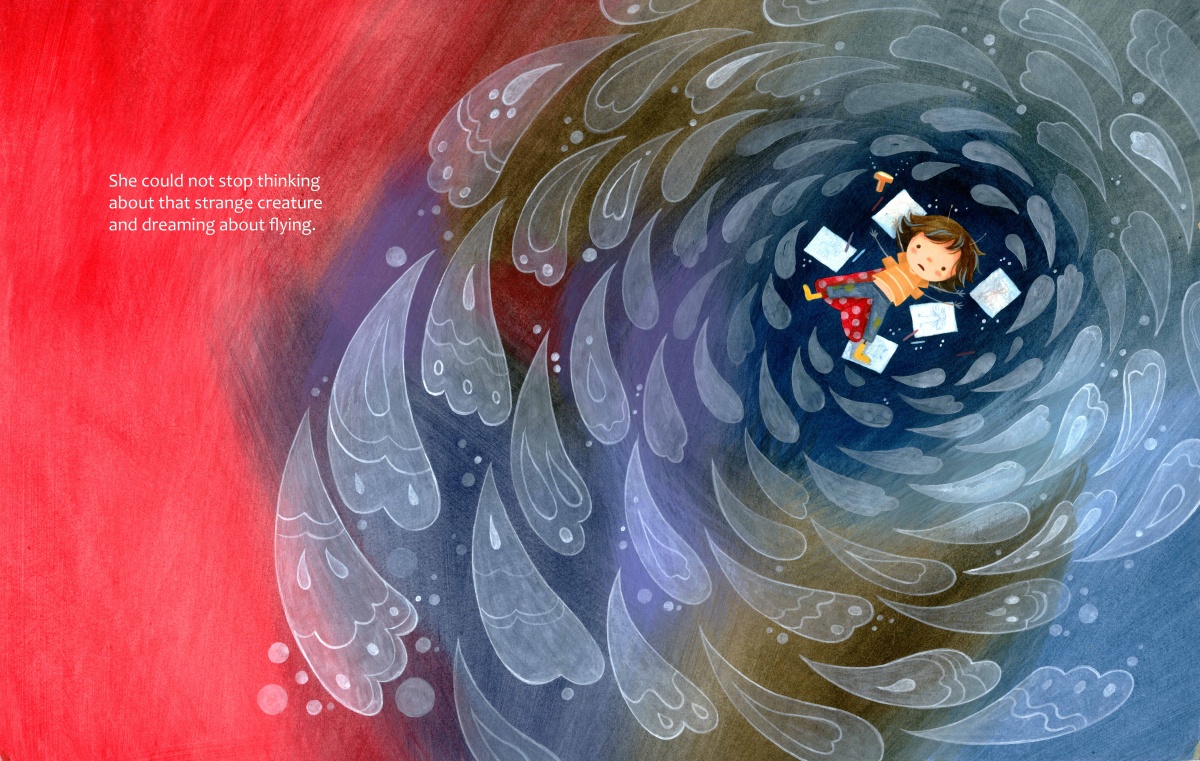
A: In a recent book project I’ve been working on, there is one illustration that stands out to me. It shows the main character in a quiet moment of reflection, realizing that there must be a reason she has wings, that they are not useless or something she needs to hide.
For me, that moment is powerful because it represents self-recognition. It is the point where she begins to see her difference not as a weakness, but as strength. Her understanding shifts, and her life begins to take on new meaning.
This image shows that sometimes the very talents and differences girls are asked to hide or minimize are, in fact, their greatest strengths.
Q: In 2024, you joined the RSC’s College of New Scholars, through the ARDAA program. What did this recognition mean to you?
A: Joining the RSC’s College of New Scholars through the ARDAA program was deeply meaningful to me. It felt like a moment of affirmation. As someone who rebuilt her academic and artistic life in a new country, this recognition signaled that my work, my voice, and my journey mattered within the Canadian scholarly community. Being part of the College also reminds me that scholarship can take many forms, including storytelling and illustration. For me, it reinforced the idea that art is not separate from research; it is a way of producing knowledge.
Q: For International Women’s Day, what message would you like to share with women and girls worldwide?
A: For International Women’s Day, I want women and girls to recognize how valuable their freedom is. Freedom is not something small or guaranteed. If you have access to education, work, movement, and expression, that is a powerful gift. Use it intentionally, for your own growth and for the wellbeing of your community.
At the same time, many women, especially in Afghanistan, are living under severe and systematic restrictions. Their rights to education, employment, safety, and even movement have been deeply limited. These are not only social challenges; they are structural realities.
In a world where some women are silenced, those who have freedom carry a responsibility. Use your freedom to stand against injustice. Use your voice. Do not allow oppression, anywhere, to become normal or forgotten. We belong to one human family, and standing up for one another is part of protecting that shared dignity.
Q: In one word, why is it important to celebrate International Women’s Day?
Voice