Kahsennarò:roks Maddy Deom (Kanien’kehá:ka, settler) is a master’s student at the University of British Columbia’s Institute for the Oceans and Fisheries. She works closely with Nations – particularly Kahnawakehró:non (people of Kahnawà:ke) – to support their fishing rights and to explore how identity and those rights are deeply connected to teiotién:taron (lake sturgeon, Acipenser fulvescens), other fish species, and the St. Lawrence River more broadly.
Last year, under the supervision of RSC College Member Andrea Reid, Kahsennarò:roks attended the Taikura Summit as part of the Tri-Academy Partnership on Indigenous Engagement. There, she learned about the power of “collectivizing,” calling for a future grounded in joy that makes space for Indigenous knowledge, communities, and lived experiences.
Q: To start us off, please introduce yourself!
A: My name is Kahsennarò:roks Maddy Deom. I am both Kanien’kehá:ka and settler, and I grew up right outside my father’s community of Kahnawà:ke, in Chateauguay, Quebec. I did my undergraduate degree in environmental science at the University of British Columbia and am now doing my master’s degree at UBC as well, in Indigenous fisheries.
Q: Can you tell us more about your studies in Indigenous fisheries and conservation?
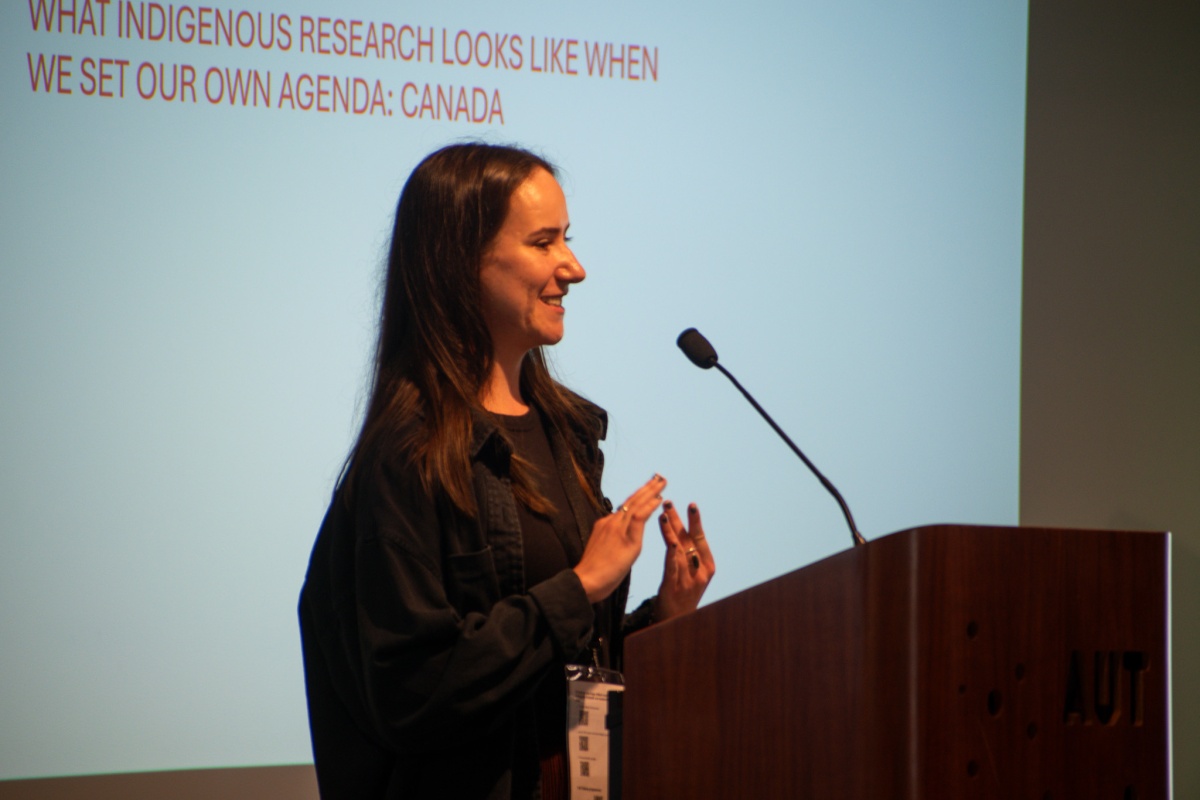
A: I am studying at the Institute for the Oceans and Fisheries, with the Centre for Indigenous Fisheries. We are a collective of students, researchers, knowledge holders, and learners who work with various Indigenous communities and Nations across Canada, the US and internationally. As academics, we work with Nations to support their fisheries, fishing tools and techniques, and their inherent fishing rights. I, in particular, am working with Kahnawakehró:non (people of Kahnawà:ke) to learn about our relationships with teiotién:taron (lake sturgeon, Acipenser fulvescens), and how our identities and fishing rights are tied to this species, other fish, and the St. Lawrence River in general.
Q: What inspired you to pursue research in this area?
A: I have loved doing work in environmental sciences since I began my post-secondary journey. Specifically, I enjoy work in ecology, biology, and Indigenous knowledge. I completed my Quebec CEGEP diploma in environmental sciences, then continued in that field in my undergraduate degree at the University of British Columbia. While in my undergraduate studies, I worked for many labs that did work in ecology and biology, and in the Centre for Excellence in Indigenous Health. While I loved working with these groups and learned so much from my experiences, I wanted to combine the focuses of all the labs I had worked in to work in Indigenous ecological and health contexts. A professor I had worked with previously pointed me to Dr. Andrea Reid and her team, the Centre for Indigenous Fisheries (CIF), and encouraged me to speak with her and see about working as a research assistant for her. And so, I began my career with the CIF in 2022 and have now become a student under Dr. Reid’s supervision.
Q: Last November, you travelled to Aotearoa New Zealand to attend the Taikura Summit as part of the Tri-Academy Partnership on Indigenous Engagement. What was that experience like?
A: It was a special experience to listen to many Indigenous researchers and scholars speak honestly about how the academy does and doesn’t serve us. It gave us a chance to reflect on why we are in the research/academia space – we want to do good work for our communities. With the presidents of each academy present, we were able to express our needs going forward as a joint society and in academia. The presidents seemed very receptive to our discussions, and they seemed willing to implement those changes.
It was also my first time speaking publicly about my master’s work. I felt comfortable speaking about my academic experience in front of this crowd, particularly because I knew that they would relate in part to what I was speaking of. I don’t think I would be as prepared to present at a non-Indigenous-focused summit or conference.
Q: What were some of your biggest takeaways from the summit?
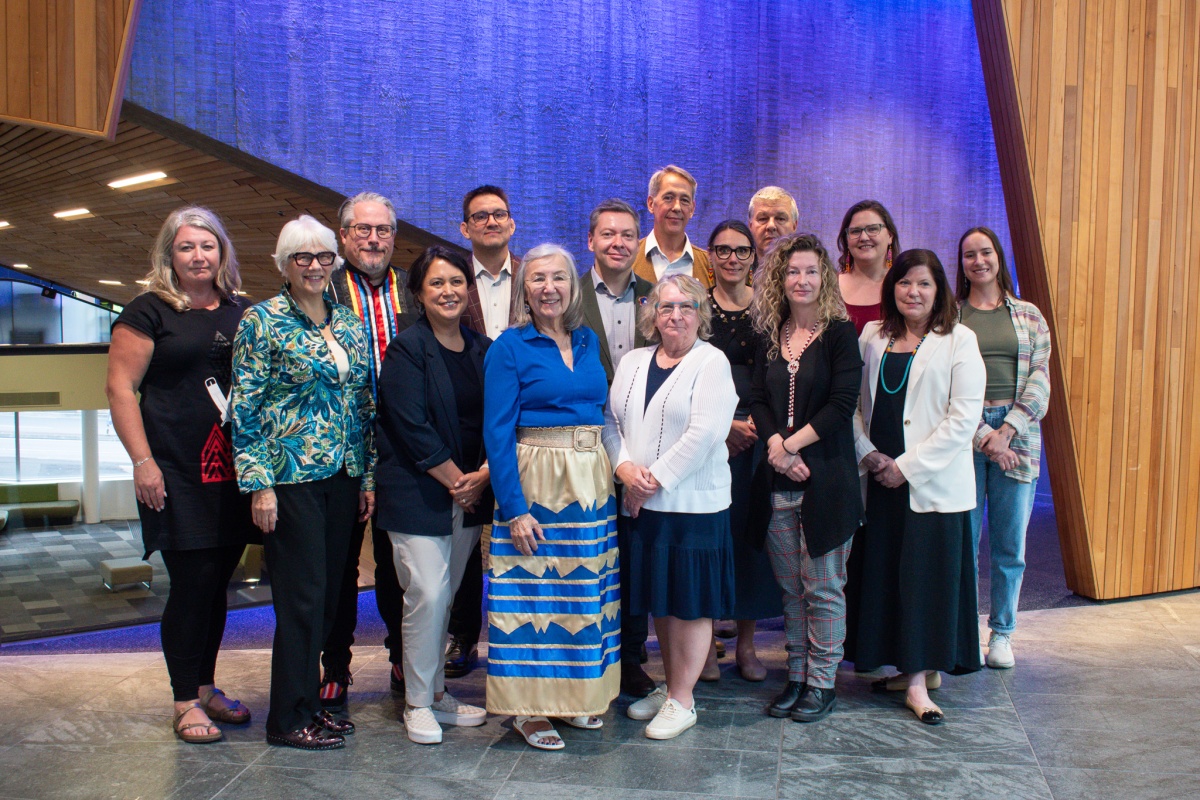
A: I noted that those attending the summit were re-affirming their reasoning for being in their fields of work. Networking with the other participants allowed us to learn about others’ inspirations for entering academia, because of their families, their communities, their connections and reconnections to their Nations, the injustices and the joys that they experienced, etc. I feel like these new and old connections reminded us that we are on the right path. Or it helped us realign, and remember that we are meant to bring our learnings and teachings back to our communities.
I was also in awe of how diverse our fields of work were. Not only throughout the entire Tri-Academy, but also within the Canadian delegation. It was affirming to see that Indigenous knowledge systems belong throughout all disciplines in the academy.
Q: How do you see those lessons being applied beyond the summit — in communities, research, or policy?
A: My hope is that bringing learnings and teachings back to our communities will contribute to our self reliance as Nations. I am so grateful to the non-Indigenous folks who work within community in good ways, and there will always be a place for them. However, there is a need for positions to be filled by community members, and a way to achieve that is to train our people directly. In my field of environmental science and protection, in particular, this is vital. Environment protection will always require scientific communication as long as we are working with external governments, so it is vital to pass this knowledge on. Our community members are already well equipped with environmental knowledge, so let’s support them to continue their work as land and water defenders.
Q: In a recent reflection piece, you mentioned the power of “collectivizing.” What does collectivizing mean to you, and what does it look like in practice?
A: I believe I discussed this in relation to Tahu Kukutai’s words at the Taikura summit when she was discussing why we called the gathering a summit rather than a conference. The gathering wasn’t only a chance to hear a select few people speak. It was an opportunity for everyone involved to be heard, to meet one another, and to continue our relationships after the conference. I think that is what collectivizing means to me – it’s to work continuously with each other to achieve our individual and collective goals. At this summit, we discussed perhaps even having a meeting outside of the Royal Society, so that we can keep in more frequent contact with each other and invite Indigenous peoples from other Nations, too.
Q: In your opinion, why is it important to celebrate National Indigenous Peoples Day?
A: I think it is important for us to celebrate Indigenous peoples every day. Native people are constantly celebrating ourselves and each other, and it feels wonderful to recognize those throughout the world, too. Particularly, I think it’s important for non-Indigenous people to recognize Indigenous People’s Day as a reminder that we are sovereign Nations, that we have relationships with the land and each other that pre-date colonization, and that we are not a monolithic ethnic group in Canada. It’s a time to remember that this type of reflection is necessary for all times of the year. It’s a day to recognize that Native joy, knowledge, love, policy, ingenuity, invention, art, defiance, etc., are alive and well!
Q: In one word: what’s a hope you have for the future?
A: Joy. As I’ve mentioned before, joy is constant, but I hope our joy can be front and centered and recognized by others as a key need for our wellbeing.