Marie-Claude Geoffroy (RSC College) does not see youth suicide as a single moment or sudden rupture. She sees it as a story — long, complex, and too often only visible in hindsight.
A professor of psychiatry at McGill University, the Douglas Research Centre, and Canada Research Chair in Youth Suicide Prevention, she works at the intersection of science, lived experience, and storytelling. Her goal is not only to understand suicide, but to change its trajectory.
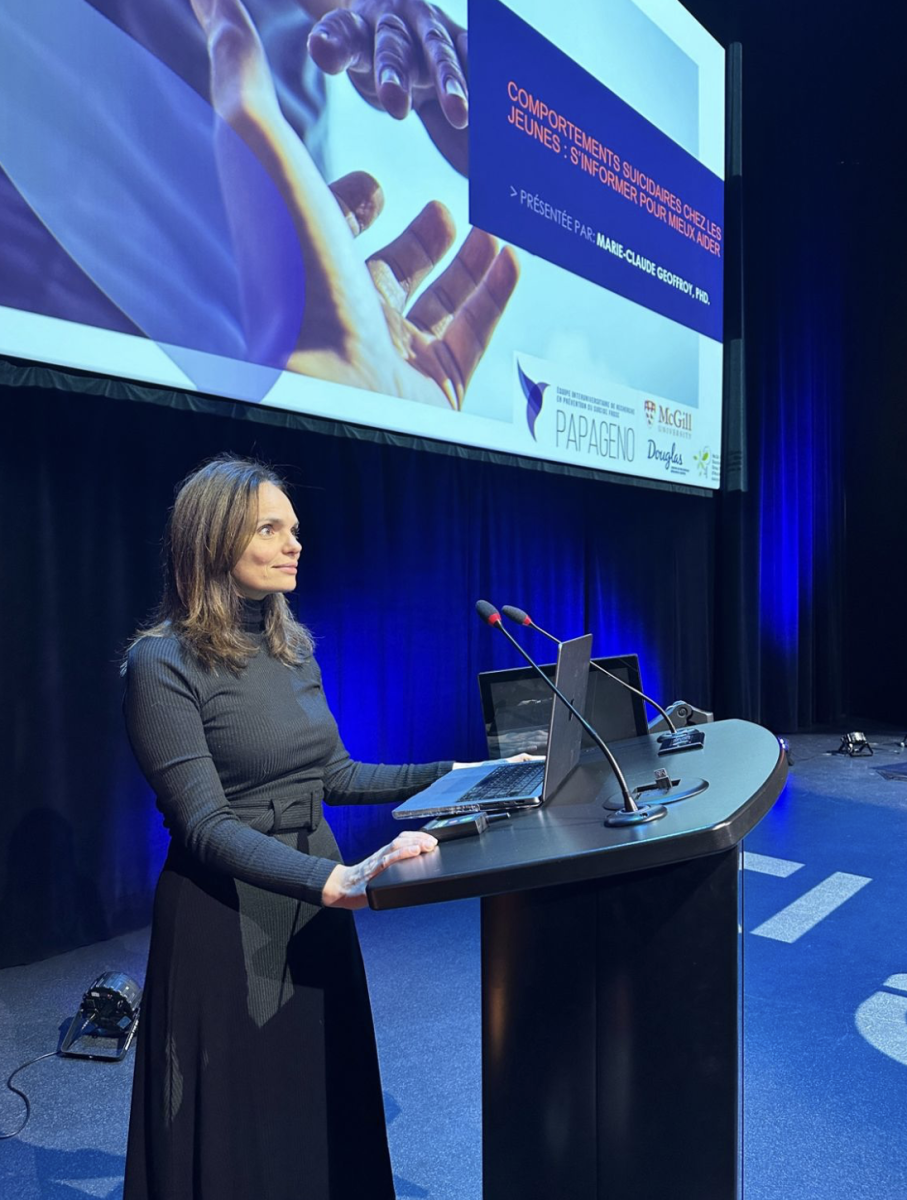
At the centre of her work is a question that runs through everything she does: how do we recognize patterns unfolding over time — and intervene before distress becomes crisis?
For Geoffroy, prevention begins with listening differently: to data, to lived experience, and to the stories that connect them.
She was first drawn not to psychology, but to storytelling. Trained in cinema and communication, she was fascinated by how people make sense of lived experience through narrative. That curiosity led her to psychology, and later to a PhD in Clinical Psychology at the Université de Montréal.
Early in her research, she studied child development and school readiness using longitudinal data — following children over time to understand how early environments shape later outcomes. It changed how she saw data.
“Data can tell a powerful story,” she says.
That insight shaped the direction of her career.
At University College London, where she trained in health epidemiology, Geoffroy turned to youth suicide prevention. Her work challenged a dominant assumption in the field: that suicide is often an impulsive response to a single event. Instead, she found that suicidal thoughts and behaviours frequently emerge along developmental pathways that begin much earlier in life.
“If we can better understand the story from the beginning,” she explains, “we may have a greater opportunity to change its trajectory.”
That idea — understanding the full story — has guided her ever since.
Back in Montreal, she worked as a clinical psychologist at the Douglas Mental Health University Institute, supporting adolescents experiencing depression and suicidal ideation. The experience grounded her research in lived reality.
“From an epidemiological lens, you see patterns,” she says. “But there are complexities of human experience that data alone cannot capture.”
Although she later stepped away from clinical practice after becoming a mother of two daughters, she continues to work closely with young people through advisory councils and participatory research. For her, youth voices are not supplementary — they are essential.
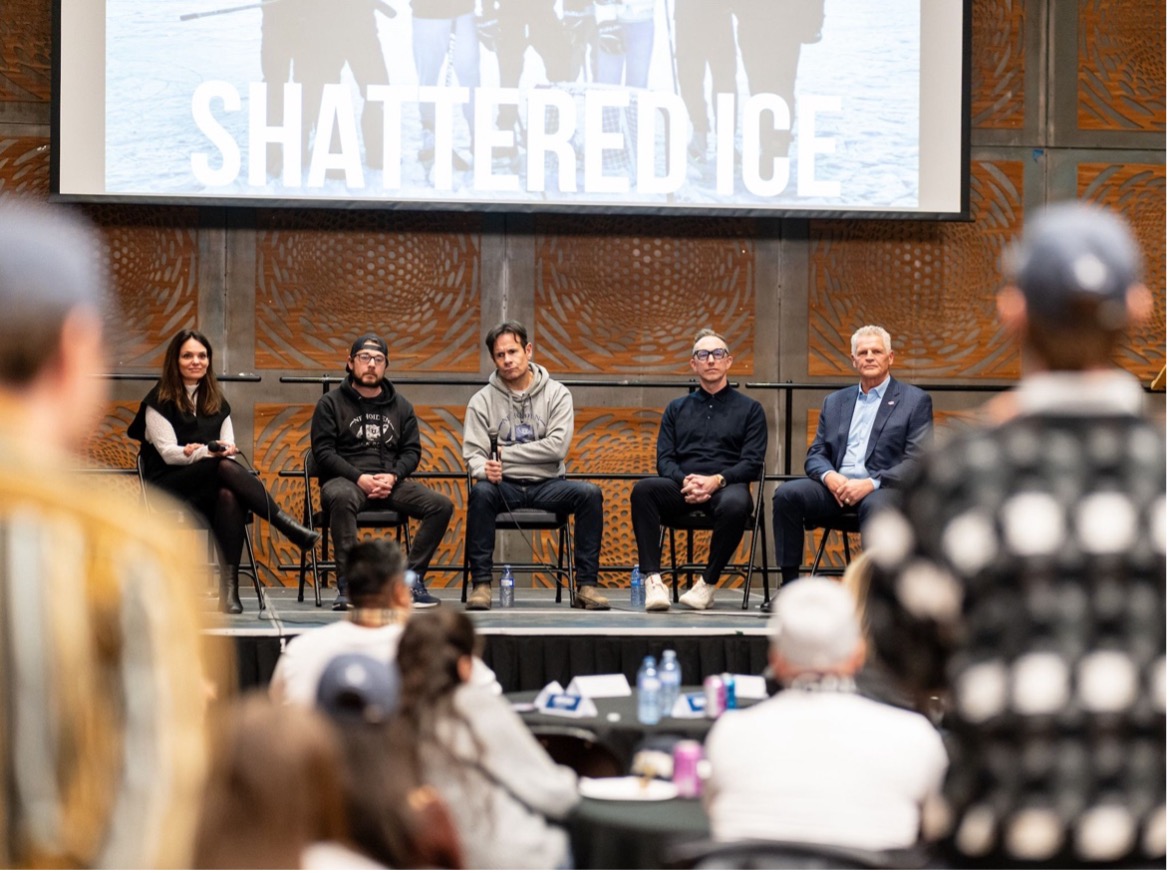
Geoffroy joins panel discussion on suicide prevention in young male athletes for premiere of "Shattered Ice"
“I try to produce knowledge that reflects real lives and real experiences,” she says.
Today, as Canada Research Chair in Youth Suicide Prevention, Geoffroy studies suicidal ideation, attempts, and deaths as connected points along a continuum. She often uses the image of an iceberg: deaths are visible at the surface, while far more experiences remain hidden beneath.
To understand that hidden landscape, she draws on multiple sources — self-reports, hospital records, mortality data, case reviews, and family interviews. Her work deliberately moves beyond the limits of any single dataset.
That approach is central to From Blind Spots to Brighter Spots, a Canadian Institutes of Health Research funded project that integrates fragmented data to better understand youth suicide risk.
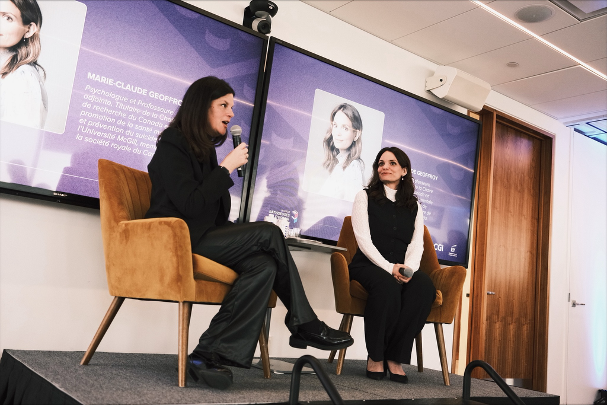
Geoffroy giving a talk about mental health of girls and women for the Douglas Foundation
The goal is to understand the full stories of those who were lost — their contexts, their pathways, and the moments where intervention might have changed their trajectory.
But for Geoffroy, understanding is not enough. These stories also need to be carried forward.
Through La Minute mentale (funded by funded by Fonds de recherche du Québec - Dialogue), a podcast she co-produces with graduate students and youth advisors, she brings researchers and adolescents with lived experience into direct conversation. Topics range from mental health in the digital age to discrimination, substance use, war, and suicide prevention.
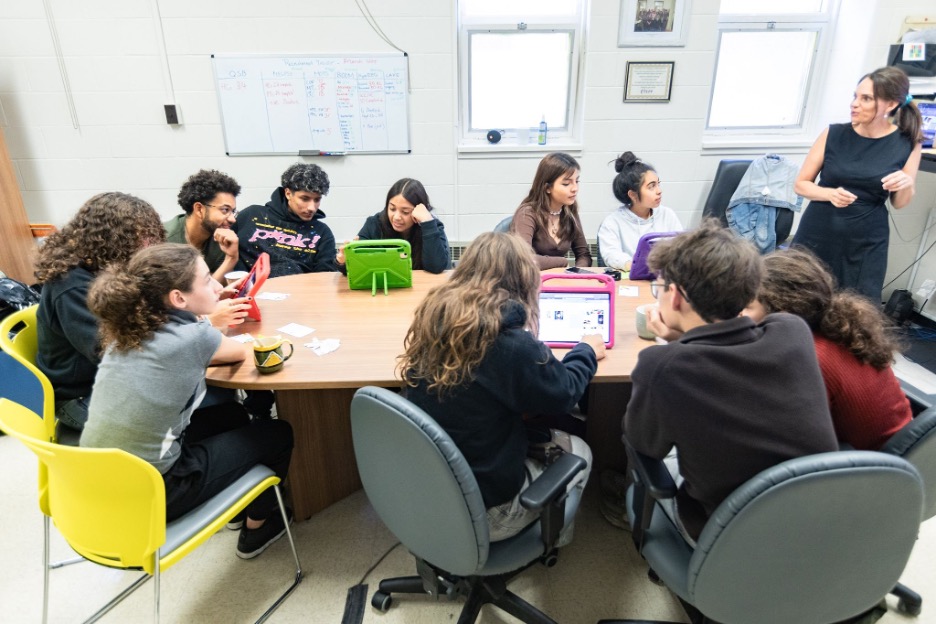
Co-design session for the podcast la Minute Mentale with youth
The format reflects a belief that runs through her work: knowledge moves in both directions. Science informs lived experience, and lived experience reshapes science.
It also reflects something more practical — meeting young people where they are, by sharing knowledge through the platforms they already use and trust.

That same philosophy guides the Papageno Research Team, which she founded in 2022. Named after a character in Mozart’s The Magic Flute who turns away from suicide after moments of human connection, the team focuses not only on risk, but on protection. Funded by Fonds de recherche en santé, the program has just been renewed until 2030.

Co-organized by Geoffroy in February 2026, an event on storytelling in science featuring guest speaker Renira Navarres (a storyteller for scientists from KT Storytelling) and Sylvanne Daniels, Director of Strategic Initiatives, Douglas Research Centre
For decades, suicide research has focused on risk. Geoffroy’s work asks a different question: what keeps young people alive? Human connection, families and schools where young people feel safe and seen, a sense of belonging, community and nature, hope. As she says, “These are also part of the story. They are part of prevention.”
Her work sits in a moment of contradiction. Public conversation around mental health has opened; stigma has declined. Young people speak more freely about anxiety and depression. Yet rates of anxiety and depression are rising, particularly among girls.
For Geoffroy, tension only deepens the urgency.
“I live with their stories,” she says. “Their stories live inside me now.”
It is a striking statement from someone whose career began in storytelling and evolved into science. But for Geoffroy, the two were never separate.
Her work insists that suicide cannot be understood through numbers alone, or stories alone. It requires both: rigorous science to reveal patterns, and careful listening to understand what those patterns mean in human lives.
And in that space between data and story, Marie-Claude Geoffroy is reshaping how we prevent youth suicide: one young person’s life, carefully understood, can change everything — for them, or for someone else.
More from Marie-Claude
Marie-Claude Geoffroy: 2023 New RSC College Member
Stream La Minute mentale, la voix des jeunes (new episode every Thursday)
Written by Paige Beveridge