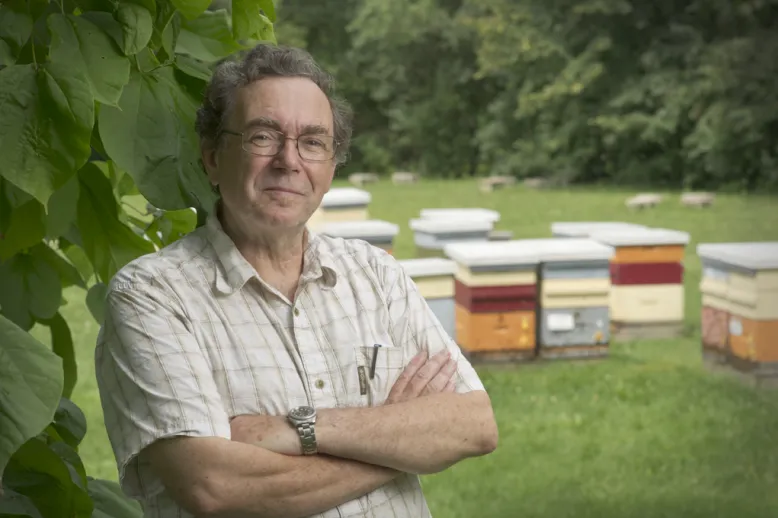
Prof. Peter Kevan
Fellow
Current Employer
University of Guelph
Election Year
2009
Academy
Academy of Science
Discipline
Plant Biology
Department
School of Environmental Sciences
Keywords
Ecosystem Function, Pollination, Insects, Plant Reproduction, Colour Vision, Micrometeorology, Agriculture, Biological Control
Peter Kevan’s extensive pioneering ecological, zoological, and botanical contributions are truly interdisciplinary. His international, Arctic-to-tropical, interests embrace ecosystem function and stress, sustainability, conservation, pollination terrain disruption and soil ecology, habitat fragmentation, pesticides, and urban ecology.
------------------
KEVAN, Peter G. –Department of Environmental Biology, University of Guelph
Kevan’s extensive pioneering ecological, zoological, and botanical contributions are truly interdisciplinary. He elucidated unsuspectedly tight pollination relations between Arctic insects and plants. His studies on floral colours link botany to insect colour vision ecophysiology. For greenhouse and field crops, his cross-cutting research on pollinators for vectoring biocontrol agents exemplifies rigorous, practical lateral thinking. A world leader in pollination conservation, he served on the US-NAS panel "Status of Pollinators in North American", leads our Strategic Network "NSERC-CANPOLIN" and is chair of the International Commission for Bee-Plant Relationships. His international, Arctic-to-tropical, interests embrace ecosystem function and stress, sustainability, conservation, terrain disruption and soil ecology, habitat fragmentation, pesticides, and urban ecology.