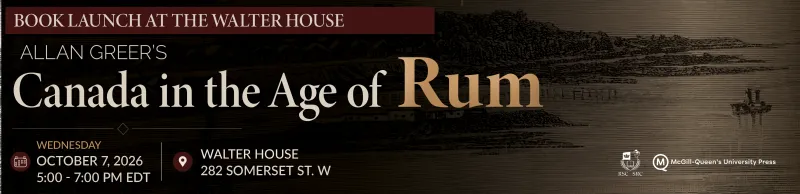
Join us for an evening featuring internationally recognized historian Allan Greer, FRSC, who will speak about his latest book, Canada in the Age of Rum. The launch will take place on October 7th at the RSC’s Walter House in the heart of Ottawa, at 282 Somerset St. W., from 5 - 7 pm.
The evening will begin with Allan Greer speaking about the commodity in Canada's complex colonial past and he will then be accompanied by historian Matthew J. Bellamy (Carleton University) in a conversation as they explore more on the book’s central themes. The floor will then be open to questions from the audience. This will be followed by a reception where attendees will have the opportunity to sample some rum punch and meet the author before concluding the night. Canada in the Age of Rum will be available for purchase and signing.
Register Here >
About the Author
Allan Greer

Allan Greer is professor emeritus of History at McGill University and Fellow of the Royal Society of Canada. Specializing in the early history of Canada in the context of the Americas and the Atlantic World, Greer has published, among other works, Peasant, Lord and Merchant: Rural Society in Three Quebec Parishes, 1740-1840; Mohawk Saint: Catherine Tekakwitha and the Jesuits; Property and Dispossession: Natives, Empires and Land in Early Modern North America. These books have won a number of national and international prizes. He has been awarded residential fellowships at Cambridge University, l'Institut d’études avancées in Paris, the British Library and the John Carter Brown Library. His work benefited from a Guggenheim and a Killam fellowship. Recently he received the Royal Society of Canada's J.B. Tyrell Historical Medal. Greer is currently writing a 15,000 year "deep history" of Canada.
Matthew J Bellamy

Matthew J Bellamy is Professor of History at Carleton University, where he teaches Canadian business, political, and cultural history. His research focuses particularly on the history of business and brewing in Canada. He is the author of Profiting the Crown: Canada’s Polymer Corporation, 1942–1990, winner of the National Business Book Award, and Brewed in the North: A History of Labatt’s. His scholarship has appeared in the Canadian Historical Review, Business History, Enterprise & Society, and the Business History Review, as well as in publications including The Globe and Mail, The Walrus, and Literary Review of Canada. His recent work examines the intersections of business, sport, and culture in twentieth-century North America.
About the Book
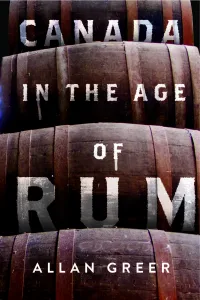
Awash in a sea of rum describes the years between the 1670s and the 1830s in the colonies that would later become Canada. Millions of litres of the sugar-based liquor were imported every year to supply a comparatively small population of colonists and Indigenous people. Why rum, and why so much?
Rum was cheap and plentiful. Intimately connected to the West Indian slave plantation complex, rum shipped to early Canada and around the Atlantic World was part of the early modern expansion of intercontinental trade known as the first globalization. Canada in the Age of Rum shows what happened to the vast quantities that came to Canadian shores. Rum was especially important to workers in the early Canadian staples industries. Fishermen and fur-trade voyageurs drank rum in massive quantities, supplied on credit and at grossly inflated prices by their employers, an arrangement that served to claw back wages and ensure the profitability of enterprises that would not have been viable otherwise. Traders deliberately sought to get hunting peoples hooked on rum in order to ensure a steady supply of pelts – alcohol was not so much a commodity for sale as it was a gift used to induce hunters to conform to the ways of the capitalist economy. However, Indigenous people drank rum in their own ways and for their own reasons; and when drinking became a serious social problem, they organized to resist it. The story ends in the 1830s when the combined effects of the temperance movement and the rise of whisky led to a sharp decline in rum consumption.
This brilliant history follows the thread of a single commodity from West Indian plantations to Newfoundland, Quebec, and the west, revealing rum as a critical lubricant of the social life of early Canada and its particular version of early capitalism.
( Provided by McGill Queen’s University Press: https://www.mqup.ca/Books/C/Canada-in-the-Age-of-Rum )
Walter House
282 Somerset Street West
Ottawa ON K2P 0J6
Canada