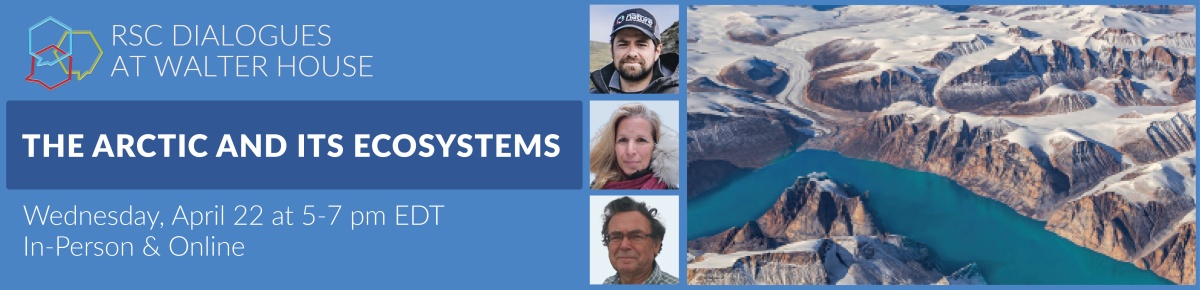
In the past decades, warming temperatures and climate change have profoundly altered the landscape and habitat of the Arctic region. Northern ecosystems are very fragile, and we are approaching a tipping point that could have serious consequences not only for northern populations but also for fauna and flora, particularly those that are endemic, resulting in a negative impact on biodiversity.
This RSC Dialogue on the Arctic will be led by Peter Kevan (FRSC) and Magali Houde (RSC College), and will explore ecology, botany, and ecotoxicology in the North, with a focus on native vegetation and insect fauna, and the protection and conservation of aquatic ecosystems, especially the bioaccumulation of environmental contaminants in Arctic wildlife essential to traditional subsistence diets.
Moderator
 Dominique Fauteux is a research scientist in zoology at the Canadian Museum of Nature and his program focuses on small mammals. After completing his undergrad at McGill University in wildlife biology, he completed his M.Sc. in 2011 at Université du Québec en Abitibi-Témiscamingue while studying the impact of forestry on wild small rodents. He then completed his Ph.D. at Université Laval in 2016 where he studied the role of predators as a mechanism behind the mysterious population cycles of lemmings in the Arctic. In 2017, he was hired at the Museum to pursue his career on Arctic wildlife biology and is currently the Arctic Centre director there since 2024.
Speakers
Magali Houde, College of New Scholars, is a research scientist with Environment and Climate Change Canada and an adjunct professor at Université du Québec à Montréal and McGill University. Her research investigates the fate of contaminants in aquatic environments and their effects on organisms. Working alongside Indigenous Peoples across the Canadian Arctic and the St. Lawrence Valley, she integrates climate factors into her contaminant research to better inform environmental and human risk assessments in Canada and beyond.
 Peter Kevan, FRSC, is a professor emeritus at the University of Guelph. His experiences in Canada’s Arctic are wide-ranging, from the High Arctic (Ellesmere Island, Resolute, Devon Island) to the treeline in the Mackenzie Delta, Churchill (MB), northern Yukon, and elsewhere. His areas of study range from terrestrial ecology, plant-insect relations, soil ecology, microbiology, micrometeorology, conservation and evolution. His global expertise spans the High Arctic, boreal environments, tropical deserts, and rain forests in the Americas, Europe, Asia, Africa and Australia.
RSC-SRC
282 Somerset Street W
Ottawa ON K2P0J6
Canada